> ## Documentation Index
> Fetch the complete documentation index at: https://docs.synclair.dev/llms.txt
> Use this file to discover all available pages before exploring further.
# Settings & extensions
> Trim the hub to the sections your project actually uses, add your own, and control who can change it.
Not every project wants all eleven surfaces. A team with no Figma doesn't need the Figma
Manifest; a project with no backend doesn't need the System Map. Carrying surfaces you
ignore makes the hub feel like someone else's tool.
`/synclair/settings` is where that gets decided.
 ## Section visibility
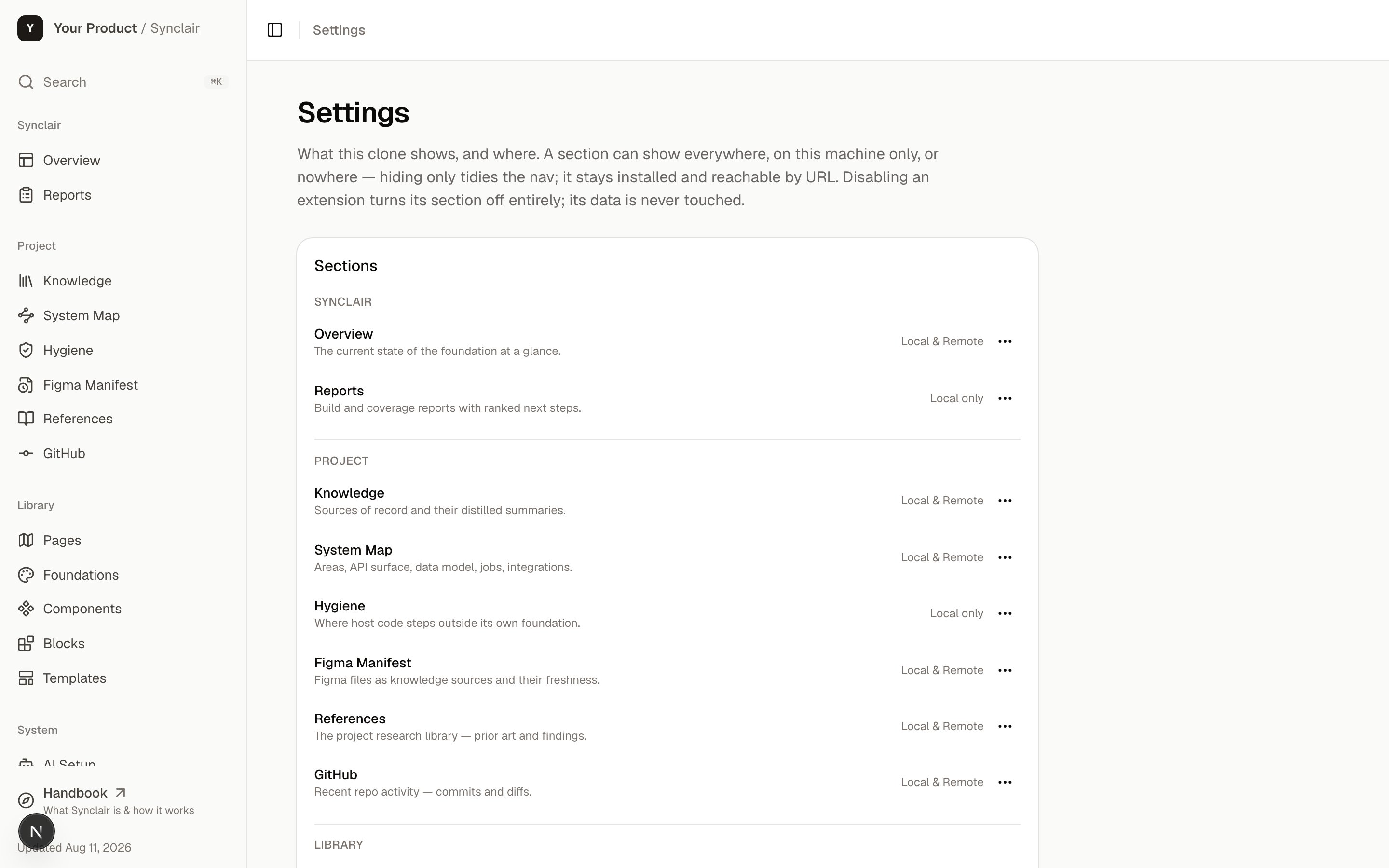
Every core section can be hidden. The list mirrors the sidebar — Overview, Reports,
Knowledge, System Map, Hygiene, Figma Manifest, References, GitHub, Pages, Foundations, and
the Library group.
Hiding is a **project decision, not a deletion**: the route and its data stay, so turning a
section back on loses nothing.
State lives in `data/extensions.json` — a file in git, like everything else here. So "which
sections this project shows" is a reviewable diff and travels with the clone, rather than
being one person's local preference.
## Extensions
Core sections are what Synclair ships. **Extensions are what a project adds** — and the
foundation ships the *contract*, not the extensions.
`EXTENSIONS` in `lib/system/extensions-manifest.ts` is empty by design. A clone appends its
own entries, and they never sync back — the same rule the rest of the seed follows.
A minimal entry:
```ts theme={null}
{
id: "my-extension",
name: "My Extension",
description: "One line, shown on the Settings row.",
layer: "project",
type: "section",
nav: { group: "Project", title: "My Extension", icon: Sparkles,
href: synclair("/my-extension"), placement: "end" },
routePrefix: synclair("/my-extension"),
defaultEnabled: true,
}
```
**Nav removal alone is not a gate.** The route's own layout is what enforces it — call
`isExtensionEnabled(id)` there and render an off notice when it's false. Taking a link out
of the sidebar hides a door; it doesn't lock it.
The governing principle for anything added here is inherited from the extensibility RFC:
**additive, all-on, reversible.** Every extension must be a no-op for an existing clone
until a human opts in.
## Who can change it
Locally there's no question — the clone is on your machine, you're its admin.
Hosted is different. The hub sits behind the deployment's sign-in gate, and admins are the
union of two lists:
| Source | Durability |
| --------------------------------------------------- | ----------------------------------------------------------------------------------------------------------------------------------------- |
| `SYNCLAIR_SETTINGS_ADMINS` (comma-separated emails) | Deploy config — survives every redeploy. **The source of record** |
| `admins` in `data/extensions.json` | Approved from the Settings UI at runtime. On a hosted container this file resets on redeploy, so UI approvals are convenience, not record |
It **fails closed** where it matters: on a hosted runtime with no identity header, nobody
is an admin.
What's safe to change across the whole foundation, what syncs from upstream, and what's
yours forever.
## Section visibility
Every core section can be hidden. The list mirrors the sidebar — Overview, Reports,
Knowledge, System Map, Hygiene, Figma Manifest, References, GitHub, Pages, Foundations, and
the Library group.
Hiding is a **project decision, not a deletion**: the route and its data stay, so turning a
section back on loses nothing.
State lives in `data/extensions.json` — a file in git, like everything else here. So "which
sections this project shows" is a reviewable diff and travels with the clone, rather than
being one person's local preference.
## Extensions
Core sections are what Synclair ships. **Extensions are what a project adds** — and the
foundation ships the *contract*, not the extensions.
`EXTENSIONS` in `lib/system/extensions-manifest.ts` is empty by design. A clone appends its
own entries, and they never sync back — the same rule the rest of the seed follows.
A minimal entry:
```ts theme={null}
{
id: "my-extension",
name: "My Extension",
description: "One line, shown on the Settings row.",
layer: "project",
type: "section",
nav: { group: "Project", title: "My Extension", icon: Sparkles,
href: synclair("/my-extension"), placement: "end" },
routePrefix: synclair("/my-extension"),
defaultEnabled: true,
}
```
**Nav removal alone is not a gate.** The route's own layout is what enforces it — call
`isExtensionEnabled(id)` there and render an off notice when it's false. Taking a link out
of the sidebar hides a door; it doesn't lock it.
The governing principle for anything added here is inherited from the extensibility RFC:
**additive, all-on, reversible.** Every extension must be a no-op for an existing clone
until a human opts in.
## Who can change it
Locally there's no question — the clone is on your machine, you're its admin.
Hosted is different. The hub sits behind the deployment's sign-in gate, and admins are the
union of two lists:
| Source | Durability |
| --------------------------------------------------- | ----------------------------------------------------------------------------------------------------------------------------------------- |
| `SYNCLAIR_SETTINGS_ADMINS` (comma-separated emails) | Deploy config — survives every redeploy. **The source of record** |
| `admins` in `data/extensions.json` | Approved from the Settings UI at runtime. On a hosted container this file resets on redeploy, so UI approvals are convenience, not record |
It **fails closed** where it matters: on a hosted runtime with no identity header, nobody
is an admin.
What's safe to change across the whole foundation, what syncs from upstream, and what's
yours forever.